
LANGUAGE OPPORTUNITIES
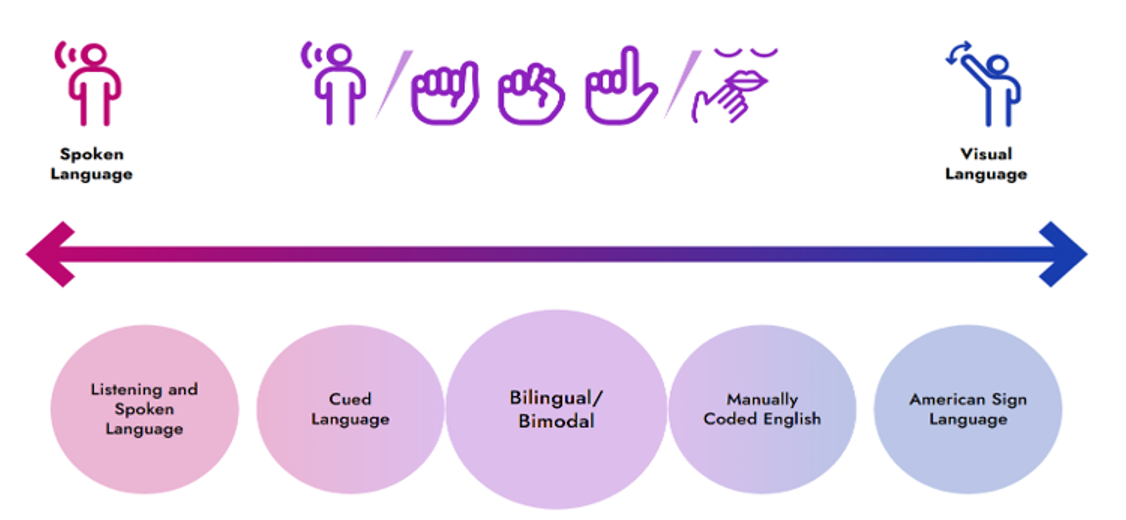
There are many ways for children who are deaf or hard of hearing to learn language. Choosing a communication approach to foster language development for your child requires time and many thoughtful decisions. What works for one family may not work for another. All communication and language approaches require a lot of family involvement and a language-rich environment. Explore the various language opportunities and resources for each below.
LISTENING & SPOKEN LANGUAGE
These methods focus on maximizing the use of residual hearing and hearing technology in order to learn the spoken language of the family. The child is encouraged to use listening to understand spoken language in their environment in order to communicate. Auditory skill development is built into the child’s daily life, as are speech and language goals. There are two approaches: Auditory Oral (AO) approach encourages the use of visuals as a supplement to listening, such as gestures and sign support. Auditory Verbal (AV) approach emphasizes listening, without visual support.
State & Local
- Megan Brown, Speech Language Pathologist, University of Kentucky: meganblandfordbrown@uky.edu
- Emily Robbins, Speech Language Pathologist, Norton Children's Medical Group: emily.robbins@nortonhealthcare.org
Other
- Hearing First
- First LSL Lessons: Family Learning - Hearing First
- First LSL Lessons Checklist
- Private Family Facebook Group
- Audiology Resource Round Up
- Tips for New Experiences with Your Baby
- Hearing First Resources Available in Spanish
- Alexander Graham Bell Association for the Deaf and Hard of Hearing
- Cochlear Corporation Sound Foundation for Babies
- National Center on Deafblindness - LSL
Cued speech is a visual system of eight hand shapes used in one of four positions around the face (called cues) that a speaker uses to clarify speech sounds and words that look alike or are not visible on the lips. Cued speech provides complete visual access to the sounds of spoken language, regardless of hearing levels, and is an effective tool for literacy development.
BILINGUAL/BIMODAL
The Bilingual Bimodal approach supports the acquisition of both American Sign Language (ASL) and spoken language. “Bilingual” refers to the fluent use of both languages. This approach includes early access to visual language, while providing the use of hearing technology for access to spoken language. The languages are kept separate, and not used simultaneously. The family prioritizes learning and using both ASL and spoken language throughout their day to day activities.
Manually Coded English Systems were developed to provide visual access to spoken English. Many families utilize Sign Supported Speech, which involves the addition of signs to support understanding of spoken language. Unlike ASL, manually coded systems use signs in English word order and may add certain signs to show the grammar of English.
ASL is a visually perceived language that uses the hands, body, and facial expressions to communicate the same kinds of words and thoughts as spoken languages. It is a formally recognized language used by the Deaf Community. ASL is a fully accessible language to children who are Deaf or Hard of Hearing regardless of their hearing levels and can be a building block to spoken language development.
State & Local
- Free ASL tutoring for KSD families: Email ASLtutoring@ksd.kyschools.us for information.
- REAL South: For families with children birth through 3. Follow the link and complete the referral form to be connected to resources, including ASL.
- American Society for Deaf Children (ASDC)
- Sign On
- ASL Connect @ Gallaudet University
- Lifeprint
- Sign It
- Oklahoma School for the Deaf
- The ASL Shop
- Hands United
- Language First
- ASL Nook
- ASL Pinnacle
- Signing Time